The Hidden Costs of Speed in Pharma Manufacturing Expansion
Pharmaceutical companies have approached capital planning in a predictable fashion over the years.
They took a long-term view of facility expansions. Forecasting manufacturing demand followed a “standard” pattern. The approval process for capital projects went through deliberate cycles, allowing time to evaluate trade-offs, budgets and portfolio priorities.
That, of course, is no longer the case.
Today, the pressures to expand faster to meet demand are outpacing their ability to adjust their capital planning processes. Add tariff uncertainty, supply chain reshoring, and AI-driven modernization initiatives, and the challenges compound.
The result: manufacturing investments are accelerating at historic levels, often while forecasting assumptions are changing. And the faster capital moves, the more expensive disconnected planning becomes.
Pharma's Manufacturing Expansion Cycle Has Accelerated
The scale of manufacturing investment across pharma and biotech over the last two years has been unprecedented.
Novo Nordisk announced plans to spend approximately $9 billion in 2025 to expand production capacity across its supply chain, including API manufacturing, aseptic production, and packaging operations.
Eli Lilly has committed more than $23 billion toward manufacturing expansion initiatives since 2020 to support surging demand for GLP-1 therapies like Mounjaro and Zepbound. In late February 2025, Lilly announced an additional $27 billion investment to build four new U.S. manufacturing facilities, which Lilly CEO David Ricks called “the largest pharmaceutical expansion investment in U.S. history.”
Meanwhile, companies including Roche and Novartis have announced staggering U.S. manufacturing commitments in response to growing tariff pressure and supply chain localization concerns. Roche alone pledged $50 billion toward U.S. drug and diagnostics facilities over five years. Across the industry, drugmakers announced plans to invest nearly $280 billion toward building out new U.S. production capacity in 2025, with Johnson & Johnson, Roche, Eli Lilly, and Novartis leading the way.
And while it would be easy to assume this is just about growth, it’s not the case. It’s about capacity resilience, geopolitical risk mitigation, and securing manufacturing flexibility in an increasingly volatile environment.
The Problem Isn't Just Spending More. It's Spending Faster
The operational challenge for pharma leaders isn’t simply that capital budgets are growing. It’s that decision cycles are compressing while project complexity is increasing.
Manufacturing expansions now involve:
- Accelerated construction timelines
- Contractor and labor shortages
- Evolving regulatory requirements
- Multi-region supply chain dependencies
- Rapidly shifting product demand forecasts
- Procurement volatility tied to tariffs and global sourcing
For evidence of this, consider the strain on the companies moving the fastest. Eli Lilly’s head of global facilities delivery, for example, has said the company is “struggling” to find the top-level project talent required for their capital expenditure projects, noting that competition for skilled construction workers such as electricians is intense across the industry. “Everyone’s building like this,” he noted. “It’s unprecedented. It’s transformational. And we haven’t figured it out yet.”
And this pressure extends well beyond GLP-1 manufacturing. Companies are simultaneously investing in:
- Biologics and cell therapy production
- AI-enabled manufacturing systems
- Automation infrastructure
- Digital quality operations
- Supply chain resiliency initiatives
- Domestic production capabilities
The result is a capital environment where priorities can shift faster than governance processes can adapt.
Traditional Capital Planning Processes Weren't Built for This Environment
Many pharma organizations still manage large portions of capital planning through disconnected spreadsheets, manual approvals, siloed procurement workflows, and static forecasting cycles – which creates serious problems when project velocity increases.
For example, small scope adjustments can become difficult to track across portfolios. Procurement changes often fail to surface until budgets are already impacted. Regional teams operate from different assumptions. And executive leadership can lose visibility into how changes in one project affect capital allocation elsewhere.
In slower environments, these inefficiencies were manageable. In today’s environment, they compound quickly. Especially when billion-dollar manufacturing initiatives compete with modernization programs, regulatory investments, and strategic R&D expansion.
Tariffs and Reshoring Are Adding Even More Complexity
Trade policy uncertainty is adding another layer of pressure to pharma capital planning.
Recent tariff discussions and proposed restrictions on pharmaceutical imports have accelerated reshoring initiatives across the industry. Following tariff pressure beginning in early 2025, 14 pharmaceutical companies announced U.S. manufacturing investments totaling more than $480 billion over the next 4 to 10 years.
Large manufacturers are now reevaluating:
- Where facilities are built
- Where APIs are sourced
- How quickly can domestic production scale
- Which projects deserve immediate capital prioritization
But reshoring pharmaceutical manufacturing is not a short-term exercise. Building new U.S. manufacturing facilities costs billions of dollars and typically takes 5 to 10 years per facility, even before accounting for the regulatory validation processes that follow construction. That means capital planning teams are being asked to make high-stakes investment decisions long before certainty exists.
Why Visibility Is Becoming a Competitive Advantage
The organizations responding best to this environment are not necessarily the ones spending the most. They’re the ones creating the clearest visibility across capital portfolios.
Those 5- to 10-year build timelines make this especially consequential. A misallocated commitment made today doesn’t surface as a problem next quarter; it surfaces years down the line, when course-correcting is far more expensive. That’s the hidden cost the headline investment numbers don’t capture.
Leading pharma enterprises are modernizing their approach to capital planning, including:
- Centralized capital governance
- Real-time forecasting
- Scenario modeling
- Portfolio prioritization insights
- Integrated procurement visibility
- Standardized and dynamic approval workflows
Why? Because when manufacturing strategies change quickly, leadership teams need to understand:
- Which projects are most critical
- Where budget exposure exists
- How scope changes affect portfolio performance
- Whether procurement commitments align with updated forecasts
- How to reallocate capital without losing operational control
That level of visibility is difficult to achieve with fragmented systems and manual processes.
How Finario Helps Pharma Enterprises Manage Capital at Scale
Finario helps large pharmaceutical and biotech organizations bring structure, visibility, and control to complex capital portfolios.
Instead of managing projects across disconnected spreadsheets and siloed workflows, enterprise teams can centralize:
- Capital planning
- Forecasting
- Approvals
- Procurement tracking
- Portfolio reporting
- Scenario analysis
This allows them to respond more quickly to changing manufacturing priorities while maintaining enterprise-wide governance.
Whether the challenge is accelerating a facility expansion, adjusting forecasts around supply chain disruptions, or prioritizing competing investments across multiple sites, Finario helps capital teams make decisions with greater clarity and confidence.
In short, speed isn’t in and of itself an advantage. “Controlled speed” is.
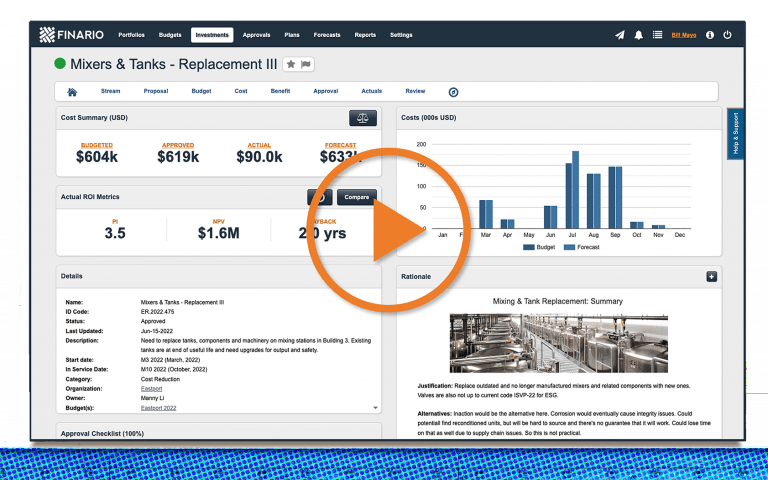
Watch our product
overview video