Capital planning software for the
modern industrial enterprise.

Built for scale, engineered for complexity

Enterprise Capex portfolios require planning and management tools built for their size and intricacy … a solution capable of accommodating thousands of active projects, hundreds of business units, and multiple ERPs and currencies. Finario is purpose-built to do just that.

It is capital planning software that meets the needs of the global enterprise at the scale actually operates.

Finario

What it means to be best-in-class

Purpose built

Dynamically handles simple asset requests or complex multi-year international projects

Highest standards of security

SOC II Type 2 security | Continuous threat monitoring with multi-level defense

Seamless integration

RESTful API for complete control of outbound & inbound data flows | Proven integrations to SAP, Oracle, JDE, Microsoft ERP, EPMs etc.

Rapid rollout

Typically two weeks to two months | Sandbox included for training and testing

Personal attention

Dedicated domestic implementation/support team | A "real person" to talk to for any need

Incredibly easy to use

Intuitive UI requires little to no training

Happy customers

4.8 rating on Capterra | Exceptional customer retention

Capex-Specific Data

Finario’s data model is built around capital projects for capturing the scope, timing and business case behind every investment decision

Single Source of Truth

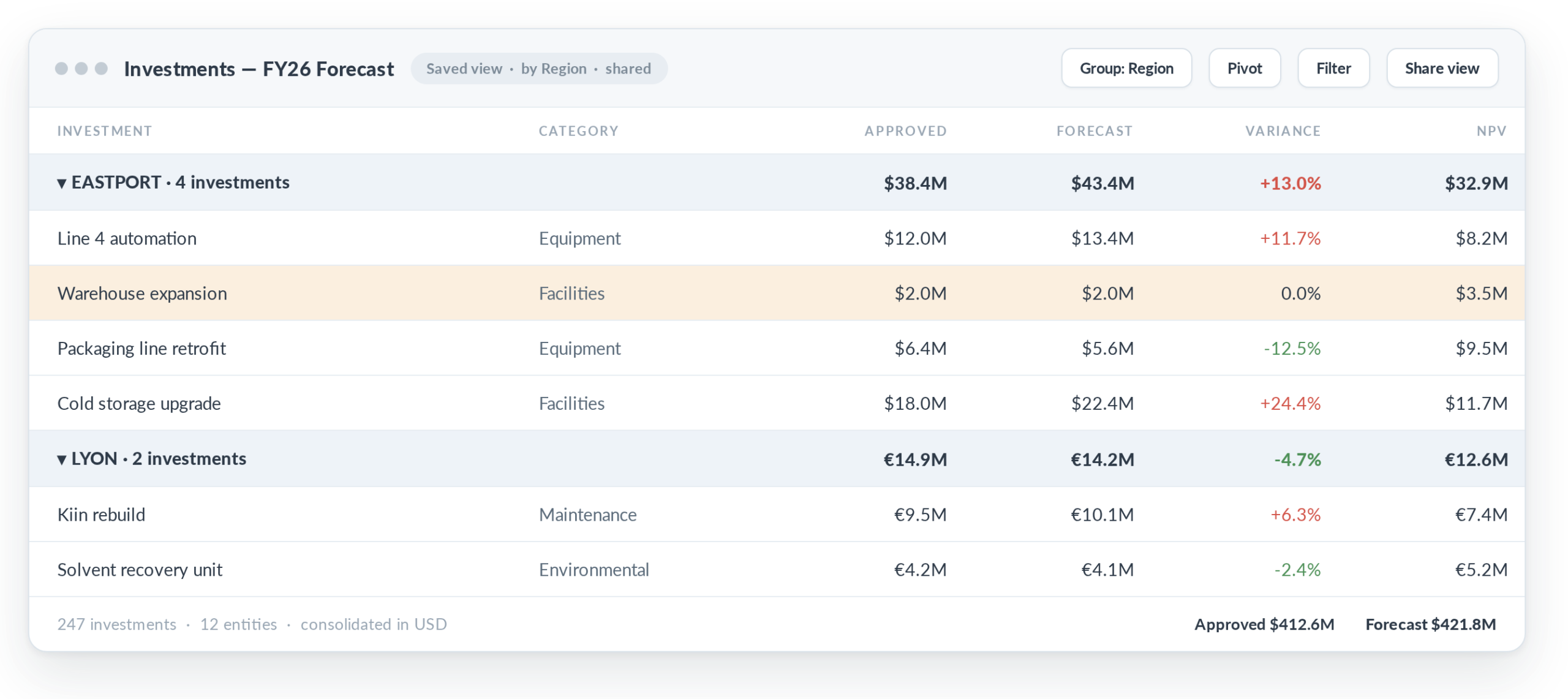
Every project, every division, every currency is in a single connected environment to replace a patchwork of spreadsheets and disconnected tools.

Financial Intelligence

NPV,  payback and and other metrics are applied consistently across all projects and business units, rather than a patchwork of approaches and models.

AI-Powered Insight

Forecast automation, predictive analytics, deep search capabilities and more are built in, with additional tools being added continuously as part of our SaaS value proposition.

One system of record

exclusively for capital expenditure

Knowing which projects were approved, how much was spent, and whether they were worth it is never in question. Your teams will be empowered to make the best decisions, faster.

— SINGLE SOURCE OF TRUTH —

Financially rigorous.

Governance-obsessed.

Not a form builder, not a single EPM line item, not a project tracker with a budget field. Finario capital planning software models the money itself and lets you control how it gets spent.

— FINANCIAL ENGINE —

Every project, scored by the same rules.

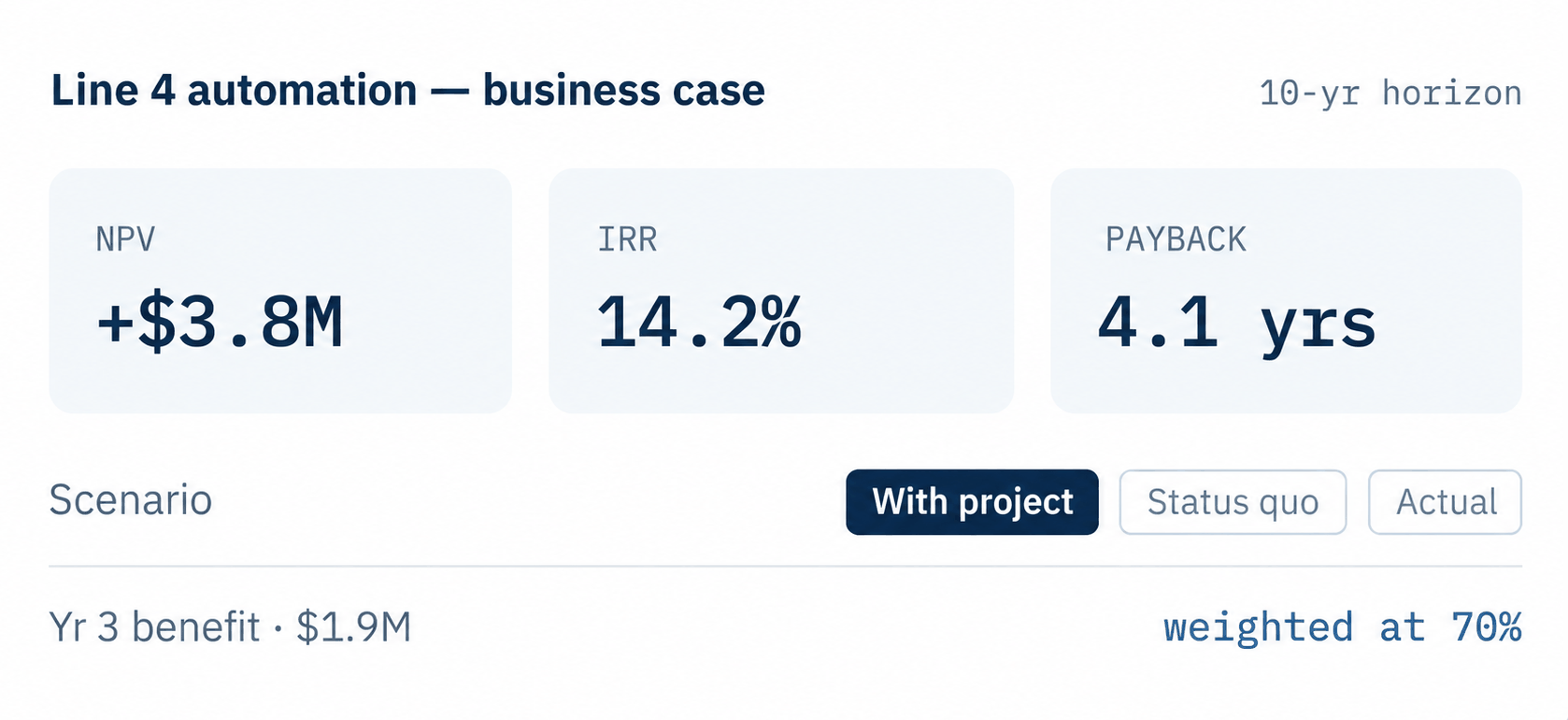
A built-in DCF engine computes NPV and payback for every material project — money out, money in, taxes, working capital — so leadership can genuinely rank a $3M warehouse expansion against a $5M production efficiency enhancement instead of comparing forty spreadsheets from forty departments.

  • Three versions of every business case: forecasted impact with the project, without the project, and what actually happened.
  • Probability-weight each year’s benefit to shrink optimistic estimates automatically.
  • One rubric across the whole portfolio;  no more apples to oranges.

— APPROVAL GOVERNANCE —

The $600K that used to slip through, doesn't.

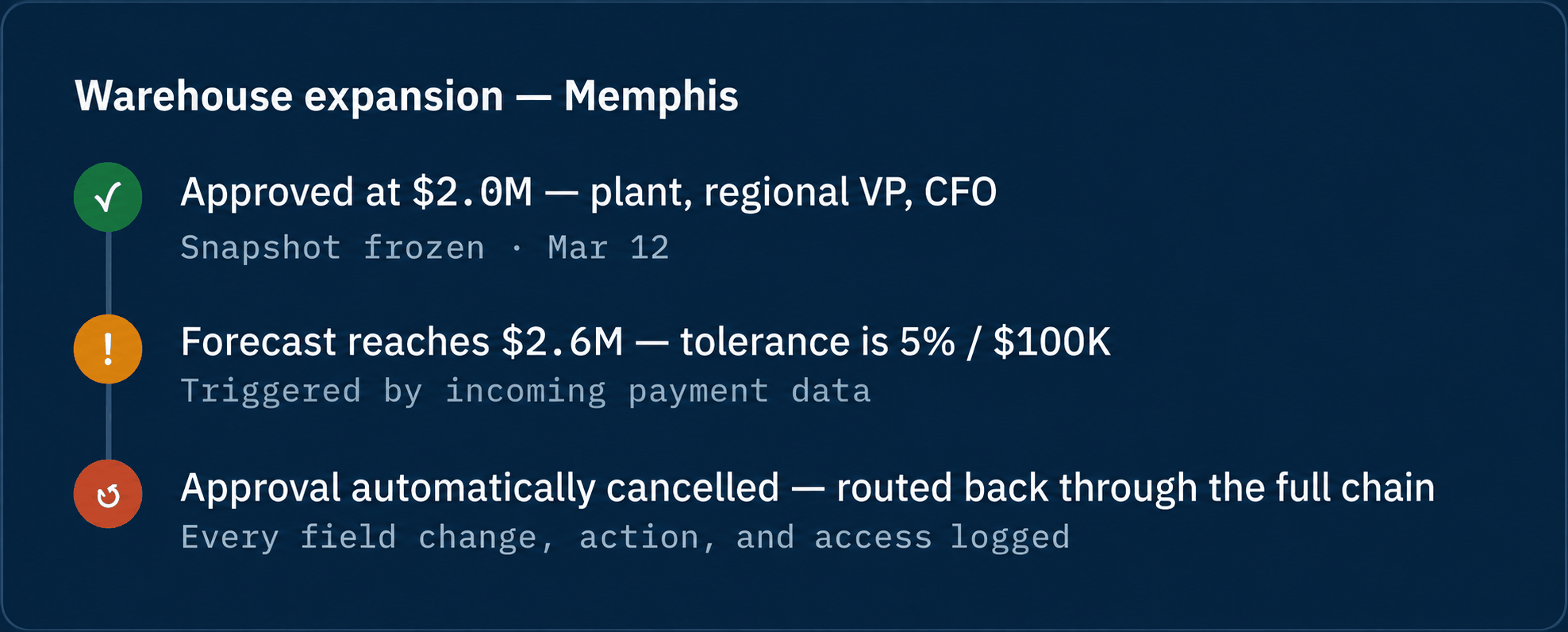
Routing rules put every request in front of exactly the right approvers. The system refuses a signature until required evidence exists. And when a project grows past its approved amount beyond your tolerance, the old approval is canceled, and the project goes back through the chain automatically.

At approval, Finario freezes a snapshot that cannot be edited afterward. When the auditor asks who approved the overrun and what they knew, the answer is one click, not a week of email archaeology.

— AUTO-FORECAST FROM ACTUALS —

The monthly re-forecasting ritual, retired.

Payment records arrive from your ERP, match themselves to the right cost line by vendor, category, and account, and update the forecast. If the new projection breaches tolerance, the project is flagged for re-approval. Your numbers are current all the time, not accurate once a month, three weeks late.

— ENTERPRISE FLUENCY —

Fluent in the calendars, currencies, and controls
large companies actually use.

Top-down meets bottom-up

Leadership sets targets from above; requests bubble up from below. Change a number anywhere and totals reconcile all the way up the hierarchy, automatically.

Multi-currency, done properly

Plan rates kept separate from forecast rates, tracked over time and pulled automatically, so that a team in another country isn’t blamed for currency moves, and real variance shows apart from exchange-rate noise.

Custom-period fiscal calendars

Native support for thirteen 4-week periods, or the range of your choosing. If your fiscal year isn’t 12 even months, every budget, forecast, and report follows your calendar; no manual translation is ever required.

Budget pools & reserves

Set contingency aside formally (“$5M reserved for equipment failures”) rather than hiding it in individual project budgets.

Overrun alerts & reminders

Set a tripwire (“email me if any project exceeds the approved cost by 10%”) and automatic nudges for due submissions and pending approvals. Deadlines won’t depend on memory.

@mentions & activity feeds

Type “@Maria” and she gets an email with context. Every project keeps a running feed of discussion and events; the conversation lives with the project, not in inboxes.

ERP Integrations — Finario
— INTEGRATION —

API-first. Proven with SAP, Oracle, and JD Edwards customers.

We won’t hand you a brochure that says “seamless connector” and leave your IT team to discover the truth after signing. Finario integrates through a documented, versioned public API; your accounting system pushes payments nightly; webhooks push approvals out the moment they happen.

Connections are built with your IT team during implementation, against real documentation, with real security controls . These include restricting each connection to approved network addresses. Old integrations continue to work as the API evolves.

Read It Before You Build It

This comprehensive guide explores the pros and cons of building Capex tools internally vs. purpose-built solutions. Packed with case studies, benchmarks, and practical insights, it’s an essential resource for finance, operations and IT leaders serious about capital allocation excellence and the capital planning software that makes it possible.

FAQs

What is capital planning software?

Capital planning software is a purpose-built platform that unifies capital budgeting, Capex request and approval workflows, forecasting, and portfolio reporting in a single source of truth. It replaces the disconnected spreadsheets and generic workflow tools most enterprises rely on, giving finance and operations leaders a real-time view of every capital project from initial request through post-completion review.

What's the difference between capital planning and capital budgeting?

Capital budgeting is one stage within the broader capital planning process. Budgeting focuses on evaluating and funding individual projects, while capital planning spans the full lifecycle — strategy and prioritization, budgeting and forecasting, Capex approval, spend tracking, and ROI reporting across the entire portfolio. Capital planning software connects all of these so decisions aren't made in isolation.

How is capital planning software different from project management software?

Project management software governs how work gets delivered — schedules, tasks, and day-to-day coordination. Capital planning software governs which investments get funded and why, focusing on financial strategy, ROI modeling, approvals, and portfolio-level visibility. The two are complementary: capital planning decides where capital should go, and project management executes once a project is approved.

Who uses capital planning software?

It's used by enterprises that manage significant, complex capital expenditure — typically across the Office of the CFO, CEO, COO, and CIO, along with FP&A teams and project sponsors. Industries with heavy capital investment such as manufacturing, chemicals, metals and mining, food and beverage, and pharma rely on it to bring rigor and visibility to capital allocation decisions.


Download our Guide(s)

Please send me the following:(Required)