Why Your Capital Planning Process Is Your Biggest Competitive Risk in 2026 — and What to Do About It
You already know the pressures.
Automation. Workforce transformation. Capacity constraints or expansion. Each one can generate legitimate capital project requests. Each one can be genuinely urgent. And all of them can land on the same constrained budget at the same time.
But here’s the question that doesn’t get asked enough: Is the problem really that you don’t know which projects to fund, or that you don’t have a process capable of telling you?
For most manufacturers, it’s the latter. And in 2026, that’s not a minor operational inconvenience. It’s a strategic liability.
Here’s what that means — and what the manufacturers getting ahead of it are doing differently.
The process most manufacturers are still using — and why it’s failing them
Describe capital planning at a typical mid-to-large manufacturer, and you’ll hear some version of the same story: projects are proposed in functional silos, evaluated on inconsistent criteria, compiled into a spreadsheet that gets reviewed once a year, approved in a Q4 budget cycle, and then largely left alone until something forces a change.
That model worked reasonably well when conditions were stable, and the project queue was manageable. Neither of those things is true anymore.
According to a 2025 Gartner survey, approximately 65% of mid-market manufacturers still use spreadsheets as their primary planning tool; and while that number may be lower in the large enterprise, it’s still surprisingly high.
Those spreadsheets are often maintained by a few people, built on formulas accumulated over years, and disconnected from the systems (ERP, procurement, operations) where the actual data lives. When an assumption changes (a tariff rate, a lead time, a compliance deadline) there’s no automatic signal. Someone has to notice, manually update the model, and re-run the analysis. If they do.
The result is a capital planning process that is structurally reactive. It can tell you what was decided. It can’t easily tell you whether those decisions are still the right ones.
What breaks when five pressures hit simultaneously
The cost of a reactive capital planning process is manageable when you’re navigating one major disruption at a time. It becomes genuinely dangerous when multiple pressure categories are generating urgent capex demands simultaneously, which is exactly the situation in 2026.
Consider what’s actually on the project queue right now for a typical discrete or process manufacturer:
- Automation investments that have been deferred for two or three planning cycles and are now operationally critical
- Trade-exposure mitigation projects such as supplier diversification, line conversions, and domestic sourcing, with timing that depends on policy conditions nobody can predict
- Workforce reskilling programs that need to be funded alongside, not after, the automation investments they support
- Energy efficiency or infrastructure projects driven by customer requirements or utility cost pressures
- Maintenance and reliability investments on aging equipment that keep getting deferred in favor of “strategic” projects
Every one of those project categories has a legitimate sponsor, a reasonable business case, and a real cost of deferral. Without a consistent evaluation framework applied across all of them, however, the projects that get funded aren’t necessarily the most strategic ones. They’re the ones with the most persistent advocates, or the most recent crisis attached to them.
According to CADDi’s 2026 Manufacturing Outlook Study, the industry is entering a phase defined by discipline, efficiency, and ROI — with manufacturers pulling back from broad expansion and shifting to targeted capital spending. The companies that execute that shift well are the ones with a process for determining what “targeted” actually means.
The hidden cost: decisions that look fine until they don’t
One of the most underappreciated risks of a fragmented capital planning process isn’t the bad decisions it produces. It’s the decisions that looked fine at approval time but were never revisited as conditions changed.
A facility expansion approved on the basis of a major customer’s demand forecast becomes a stranded asset if that customer’s business contracts. An automation investment sequenced without regard to workforce readiness sits underutilized for 18 months while training catches up. A tariff-driven reshoring project locks in capital commitments just before trade policy stabilizes and the original supplier economics return.
None of these are hypothetical. All of them are happening right now. And in most cases, the root cause isn’t bad judgment at the point of approval. It’s the absence of a mechanism to surface changed assumptions and trigger a reassessment before the capital is deployed.
This is the hidden cost of the annual planning cycle: not just that it produces imperfect decisions, but that it has no natural feedback loop. Once a project is approved, it stays approved until something goes visibly wrong, by which point the options are usually expensive.
What good looks like: the five disciplines of a modern capital planning process
The manufacturers navigating this environment most effectively share a common set of process disciplines. None of them are complicated. All of them require deliberate investment in how capital decisions are made — not just what decisions are made.
1. A single portfolio view across all projects and business units.
Capital decisions made in functional or geographic silos produce duplication, missed synergies, and distorted prioritization. A single, consolidated view of the full project pipeline — proposed, approved, and in-flight — is the foundation everything else builds on. Without it, there’s no way to make trade-offs across competing demands.
2. Consistent evaluation criteria applied to every project.
Strategic alignment, financial return, cost of deferral, execution readiness: every project in the portfolio should be scored on the same dimensions, with the same definitions, every time. When evaluation criteria vary by project type, business unit, or who’s in the room, comparisons become meaningless and advocacy wins over analysis.
3. Explicit posture assignments — Freeze, Flee, or Build — with defined trigger conditions.
Every project should carry a current posture designation and a set of documented assumptions that would change it. A Freeze without a defined trigger is just a project that never gets revisited. A Build without documented assumptions is a commitment that can’t be stress-tested when conditions shift.
4. A quarterly review cadence, not an annual one.
The Capex Council concept — a standing cross-functional review with operations, finance, engineering and IT at the table — exists specifically to surface the assumption changes that would materially affect project rankings. Not to re-litigate approved projects. Not to create bureaucracy. To ask, on a regular cadence: what has changed, and does anything in the portfolio need to move?
5. Technology that makes the process continuous, not periodic.
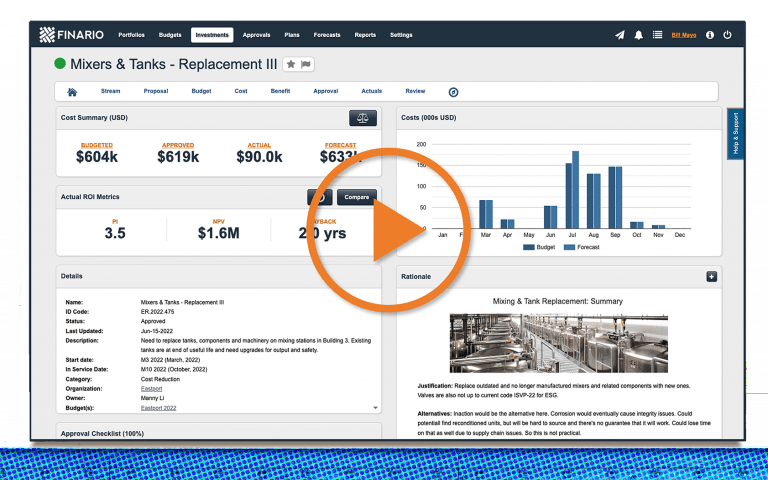
Spreadsheets can support a capital planning process. They cannot power one. A purpose-built enterprise capital planning platform connects project evaluation to live financial data, tracks actuals against forecasts in real time, and gives leadership a dashboard view of the full portfolio — including the projects that are drifting from their original assumptions. The difference between a process that updates annually and one that updates continuously isn’t a minor efficiency gain. In a volatile environment, it’s the difference between catching a problem early and discovering it late.
The planning questions every manufacturer should be asking right now
Before the next capital cycle opens, operations and finance leaders should be able to answer these questions cleanly:
- Do we have a single, consolidated view of all capital projects across every business unit and facility?
- Are we evaluating every project on the same criteria — or does each function use its own scorecard?
- For every project currently designated as deferred or on hold, what are the specific conditions that would reactivate it?
- When did we last reassess the assumptions underlying our three largest approved projects?
- If our top two automation investments were delayed 18 months, what would the operational impact be — and is that impact quantified?
If any of those questions produce a slow or uncertain answer, the process gap is real — and the risk is already accumulating.
From planning ritual to competitive advantage
Capital planning has always mattered. What’s changed is that the cost of doing it poorly has risen sharply — and the gap between manufacturers with disciplined processes and those without is widening faster than it has in decades.
The five pressures described in the main article — tariffs, automation, workforce, energy demand, and broken prioritization — are not going to resolve themselves. But they are manageable for manufacturers that treat capital planning as a live, continuous discipline rather than an annual budget ritual.
The winners in this environment won’t necessarily be the ones with the most capital. They’ll be the ones who know, at any given moment, exactly where their capital is going — and exactly what would make them change their mind.
That’s not a technology problem. It’s a process problem with a technology solution. And it’s available right now, to any manufacturer willing to invest in getting it right.
Click here to learn how Finario’s Portfolio Strategy and Capital Planning solutions are purpose-built for exactly this challenge.
Watch our product
overview video