

INSIDER PERSPECTIVES

FOR CAPITAL INVESTMENT STAKEHOLDERS

The paper and packaging industry is facing a moment of truth.

While industry growth is now projected to increase from approximately $458.8 billion in 2025 to $583.9 billion globally by 2030 – a steady 4.9% annual growth rate (Mordor Intelligence, 2025) – it’s still a fraction of the explosive pandemic-era surge that drove recent capacity additions. As a result, many operators now face a mismatch: infrastructure sized for yesterday’s trajectory confronted by today’s steadier demand.

The smartest operators in paper and packaging recognize that past success doesn’t guarantee future returns. That success in 2026 won’t be rewarded to the biggest spenders, but rather the most disciplined ones.

The Era of "Prove It First" Capital Planning

Walk into any board meeting at a leading P&P company today, and you’re apt to hear a very different conversation than you would have in 2020. For example:

International Paper is maintaining its $1.9 billion annual capital budget while simultaneously closing four U.S. plants, citing containerboard oversupply and margin squeeze (Seeking Alpha, 2025). Mondi delayed a planned paper machine investment and restructured from three business units down to two, a clear signal of capital deferral due to weak demand and falling prices (Reuters, 2025). Graphic Packaging’s FY25 guidance held steady at approximately $850 million, not growing, not shrinking, but emphasizing cash discipline and return thresholds (Seeking Alpha, 2025).

A common thread? Capital discipline isn’t a buzzword anymore. It’s survival.

Moreover, there appears to be a noticeable shift from  “where can we expand?” (greenfield) to “where can we extract more value from what we already have?” (brownfield).

Four Forces Reshaping Capital Priorities

1. Energy Transition: Finally Making Financial Sense

For years, sustainability projects lived in a special category, the “we know we should do this” bucket that required executive air cover to justify weak ROI. Not anymore.

Biomass boilers, waste-heat recovery systems, and on-site renewables are now crossing the payback threshold that makes finance teams genuinely excited. We’re talking sub-four-year horizons in many cases, driven by volatile fossil fuel costs and improving clean technology economics.

The real game-changer? Hybrid power systems that let mills hedge their energy bets. When grid power spikes, you lean on your solar array. When the sun doesn’t cooperate, you’ve got backup. This kind of operational flexibility used to be a luxury. Now it’s table stakes.

And here’s where it gets interesting: AI and digital twins are turning energy management from an art into a science. Mills can forecast consumption patterns, optimize production schedules based on electricity pricing, and identify inefficiencies before they metastasize into cost overruns. Smart mill retrofits and modular, scalable automation upgrades are replacing those behemoth greenfield projects that tie up capital for years before delivering a single dollar of value.

2. Circular Economy: From Marketing Slogan to Competitive Weapon

Circularity used to be something you put in your annual sustainability report to make investors happy. Now it’s something your customers are writing into RFPs.

The global circular packaging market reached $244.72 billion in 2024 and is expected to expand at a CAGR of 6.3% through 2030, with paper and cardboard accounting for over 40% of market share (Grand View Research, 2024). Major fast-moving consumer goods (FMCG) brands aren’t asking if you can deliver recycled content and closed-loop solutions; they’re asking how much and how fast. This shift has turned fiber recovery, chemical recycling, and lightweighting from nice-to-haves into must-fund priorities.

The smartest moves? Co-located facilities with brand partners that enable true closed-loop supply chains. Regional hubs with modular capacity that let you scale up or down based on actual demand rather than forecasts that were outdated before the ink dried.

What’s fascinating is how circularity is driving capital strategy in unexpected ways. Instead of building massive centralized recycling facilities, companies are investing in distributed networks that improve agility and reduce transportation costs. Contemporary paper mills are increasingly utilizing recycled fiber content, with some facilities achieving recycling rates exceeding 87%; this significantly outperforms plastic packaging, which achieves only 42% recycling rates across European markets (Packaging World Insights, 2025). The old model was about scale. The new model is about speed and resilience.

3. Regulatory Compliance: The Hidden ROI Opportunity

Compliance spending has traditionally been viewed as a cost center – a necessary defensive play rather than a strategic investment. The EU’s Packaging and Packaging Waste Regulation (PPWR), which entered into force on February 11, 2025, and will apply from August 12, 2026, represents one of the most comprehensive regulatory overhauls the industry has faced (European Commission, 2025). The regulation mandates that all packaging on the EU market must be recyclable in an economically viable way by 2030, while establishing minimum recycled content requirements and extended producer responsibility (EPR) frameworks that fundamentally reshape the cost structure of packaging operations.

But here’s what the leading companies figured out: compliance capital can deliver real returns if you’re strategic about it.

Investments in recycled fiber systems, deinking technology, and closed-loop logistics aren’t just about avoiding fines. They’re about positioning for premium contracts with brands that need compliant suppliers. They’re about risk mitigation when regulations tighten further (and they will). And increasingly, they’re about accessing policy incentives and tax credits that can meaningfully improve project economics.

The revelation? When carbon and water disclosure gets integrated into board-level capital decisions, not treated as a side conversation, the sustainability team handles compliance spending starts looking a lot more like a strategic investment.

4. Plastics Substitution: The Technical Challenge Everyone Underestimated

Replacing plastic packaging with paper sounds simple until you try to do it at scale while maintaining barrier properties and food safety.

This is where serious capital is flowing: barrier coating technologies, food-safe paper line upgrades, and quality control systems that can verify performance without slowing production. Brands want sustainable alternatives, but they’re not willing to compromise on shelf life or product integrity.

The companies winning here aren’t just buying new equipment; they’re building R&D partnerships, running pilot lines, and treating innovation as a continuous capital investment, not a one-time project.

What Best-in-Class Looks Like in 2026

The operators getting capital planning right aren’t following a single playbook, but rather converging on a few core practices:

They’re integrating ESG, ROI, and risk into every capital case. No more siloed analysis where sustainability lives in one spreadsheet and financial returns live in another. Every project gets evaluated on a unified set of criteria that includes carbon impact, regulatory risk, and cash flow contribution.

They’re paranoid about cost overruns. Inflation and supply chain volatility have made budget accuracy feel quaint. Leading companies are building in contingency buffers, using fixed-price contracts where possible, and implementing stage-gate reviews that enable them to pull the plug on underperforming projects before they drain resources.

They’ve abandoned the “just in time” inventory mentality. The past few years taught us that efficiency without resilience is fragility with a fancy name. Smart operators are holding more buffer inventory, diversifying supplier bases, and building supply chain optionality into their capital planning even when it costs more upfront. 

They’re investing in consumer-driven innovation. Freshness indicators, tamper-evident seals, enhanced recyclability: these features haven’t justified capital spending in the past. Now they’re competitive differentiators that customers will pay for. The capital planning conversation has expanded beyond “can we make more boxes?” to “can we make boxes that solve new problems?”

They’ve embraced rolling forecasts and zero-based budgeting. Annual capital planning cycles feel increasingly inadequate when market conditions shift quarterly. The best operators are moving to continuous planning models that let them reallocate resources quickly and challenge every assumption, every time.
The Finario Perspective: Visibility Is the New Competitive Advantage

Here’s what we’re seeing across our client base: the companies navigating uncertainty most successfully aren’t necessarily spending more; they’re seeing more.

They have real-time visibility into project performance. They can model scenario analyses in hours, not weeks. They can connect capital decisions to strategic outcomes and prove ROI with data, not hopeful projections.

In an industry facing margin pressure, volatile input costs, and evolving customer demands, capital planning can’t be an annual exercise that produces a budget spreadsheet. It has to be a dynamic capability that lets you sense market shifts, evaluate tradeoffs, and move resources to the highest-value opportunities.

The paper and packaging companies that will thrive in 2026 will be those that can answer three questions faster and more accurately than their competitors:

  • Which projects will deliver measurable returns in this environment?
  • Where are we overexposed to risk, and how do we hedge it?
  • What can we stop spending on to fund what actually matters?

Because in an era of capital discipline, the real competitive advantage isn’t how much you can spend, it’s how well you can choose.

See It in Action

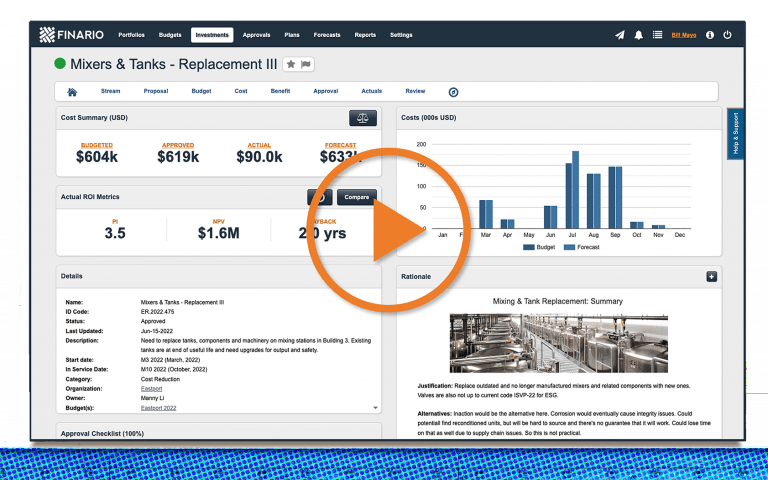
We recently hosted a webinar tailored for paper and packaging leaders facing these challenges. The session covered industry-specific trends and shared best practices from leading P&P companies. Most importantly, we provided a live demonstration of how enterprise capital planning software operates in practice, through real workflows, authentic decision-making processes, and actual ROI modeling.

Watch our product
overview video

capex software ui