The Mid-Year Capital Plan Lookback
A golden opportunity to course-correct before budget season locks you in again.
A lot has probably changed since you locked in your budget six months or so ago.
Have the implications of that gone largely unnoticed?
Unfortunately, for many companies that are more reactive or structured in their approach to capital allocation, the answer can be “yes.”
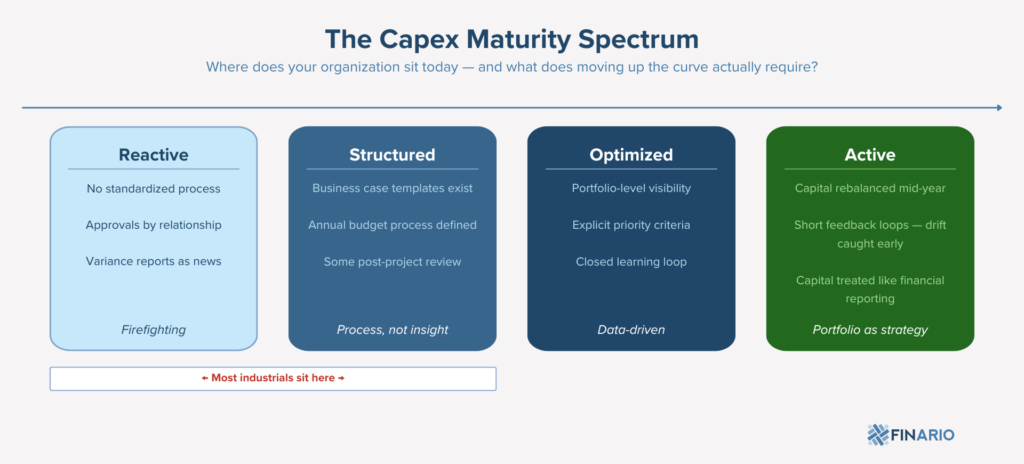
Input costs can rise, projects can slip behind their milestones, marketplace shifts can impact strategic priorities, or geopolitical factors can throw cold water on assumptions. All of these can cause the ROI models and underlying forecasts on which Capex plans were based to deviate quickly.
The result: If those plans aren’t being continuously monitored, routinely reassessed, and aggressively reconsidered, projects will be overspent, opportunities will be missed, and growth will be reduced.
It’s why, as we approach the mid-mark of the calendar year, it’s a good time to do a proper lookback and give serious thought to charging forward with a new approach to capital planning.
The gap between tracking, managing and optimizing
There’s a meaningful difference between tracking capital and optimizing. Tracking and managing produces variance reports and manufactures decisions. Optimizing ensures the enterprise gets the maximum benefit from the investment.
At the midyear mark, that gap can show up most clearly. That’s because, for companies with calendar fiscal years, there are six months of actuals in the books and six months of budget remaining; so there’s enough history to distinguish a temporary variance from a structural one, and enough runway to do something about it. Finance teams that treat this moment as a simple routine reforecast are leaving value on the table.
That’s because a reforecast answers the question: What will we spend? It adjusts the numbers to reflect the current project status and timing. A mid-year re-decision asks something harder: What should we spend — and on what? It treats the remaining budget as a resource to be actively allocated, not a plan to be passively tracked.
The distinction is especially consequential in capital-intensive industries, where Capex commitments are sticky. Projects already underway carry momentum: organizational, contractual, and “political.” Waiting until the Fall budget cycle to surface the fact that three of your top ten projects are consuming capital without delivering milestones can have a snowballing effect throughout your organization.
Treating your lookback period as a mid-year “mini” budgeting exercise, however, provides an opportunity to take a hard look at your portfolio, decide what to continue, modify or stop, and set the groundwork for capital optimization.
Five questions worth answering right now
A structured mid-year capital review doesn’t require reinventing the governance calendar. It involves asking the right questions with actuals in hand:
- Which projects are behind on milestone delivery, not just on budget? A project tracking to plan on spending, but two months behind schedule, is accumulating cost risk.
- Where have underlying assumptions changed materially? Interest rates, contractor availability, regulatory timelines, and input costs have likely all shifted since November. Which projects were approved under conditions that no longer exist?
- What has changed in strategic priority? Business conditions evolve. Some initiatives approved in Q4 are more urgent today; others are less. The mid-year review is the right moment to test that ranking.
- Are there active projects that are effectively stalled? “Zombie capex” — initiatives that are neither progressing nor formally canceled — tie up budget authority and distort the portfolio view. Mid-year is the time to make the call.
- What does second-half cash demand honestly look like? Not the original forecast; the realistic version, based on current project status, procurement commitments, and execution timelines.
The mid-year capital review framework
The argument for passive mid-year management is seductive: budget season is only a few months away, the team is stretched, and reopening capital decisions can be politically difficult.
But passive management has real costs. Capital allocated to underperforming projects isn’t redeployed to higher-return projects. Finance leaders who surface material surprises in October instead of June give the board less time to respond and the CFO less credibility in the room. And the annual budget cycle that follows absorbs all of this: the project that should have been stopped in June shows up as a cautionary tale in next year’s planning process.
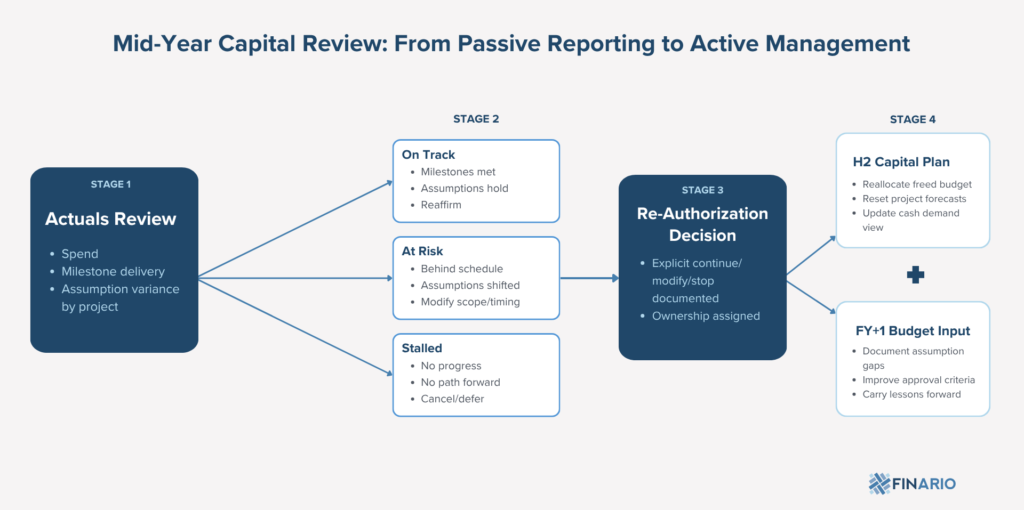
A better approach is to treat the mid-year review as a structured re-authorization of the capital plan: a disciplined moment to confirm which projects should continue as approved, which need scope or timing modifications, and which should be stopped or deferred. This is not a wholesale re-budgeting exercise, mind you; it’s a clear-eyed checkpoint with documented decisions and ownership assigned.
What this requires in practice
Doing this well starts with having the requisite Capex-specific data. That’s where purpose-built capital planning software, such as Finario, earns its stripes. That’s because one of the core reasons finance teams default to passive mid-year management is the difficulty of getting a clear, current view of the entire capital portfolio. When project data lives in spreadsheets, ERP systems, and email threads, assembling the picture takes long enough that the window for action has effectively closed before the analysis is complete.
Finario customers consistently cite real-time portfolio visibility as the capability that makes active mid-year management practical rather than aspirational. When every project’s spend actuals, forecast, milestone status, and original business case are in one place — accessible without a multi-day data pull — the mid-year review becomes a strategic governance event rather than a heroic data exercise.
HACKETT GROUP RESEARCH
Digital World Class® finance organizations spend 57% less on planning and forecasting than their peers — while investing significantly more time in business analysis and insight generation. The best-performing finance teams have shifted the work toward judgment, doing less data assembly and more decision-making, more often.
Source: The Hackett Group, Digital World Class® Finance Research
July is an asset. Use it.
The companies that manage capital well don’t just plan well in November. They make decisions continuously, particularly at the moments when the temptation to coast is highest. June is one of those moments.
A best practice for doing this is to create a Capex Council: a cross-functional governance group comprising leaders from finance, operations, IT and procurement who are responsible for overseeing and optimizing capital expenditures. Their mandate is to align the company’s largest capital investments with high-level strategic objectives, monitor the viability and performance of ongoing projects, reallocate resources when priorities shift or business conditions change, and champion post-completion reviews.
Ultimately, the question isn’t whether your capital plan needs revisiting. It does. The question is whether you’re going to do something about it.
Finario provides a suite of enterprise capital planning and portfolio strategy solutions built for industrial companies that need visibility, control, and confidence across the full Capex lifecycle — from business case to close. Learn more at finario.com.
Watch our product
overview video