The Capex conundrum for companies growing exponentially in the AI data center supply chain ecosystem.
The benefits and risks of getting too far ahead of demand.
All eyes are on the AI hyperscalers and neoclouds, and it’s easy to see why. Microsoft, Alphabet, Amazon, and Meta alone are on track to spend at least $700 billion in total capital expenditures for 2026.
Yes, that spending creates opportunities and challenges for the Data Center Physical Infrastructure (DCPI) providers; every dollar a hyperscaler commits turns into an order for someone else: a generator manufacturer, switchgear plant, fiber optics manufacturer, steel mill, cement or steel supplier, and so forth. But they also face the challenge of weighing the capacity and costs needed to meet demand against longer lead times, less visibility, competitive uncertainty, and far less room for error than the customer who set it all in motion.
In short, high demand doesn’t eliminate Capex risk. It makes disciplined capital planning far more important.
The AI Infrastructure Spending Wave
Let’s start with the big picture. McKinsey’s The Cost of Compute projects that data centers worldwide will need about $6.7 trillion in investment by 2030. Roughly a quarter of that, about $1.3 trillion, will go to power generation and transmission, cooling, and electrical equipment. To get there, McKinsey’s range for AI-related capital needs is wide: about $3 trillion to $8 trillion, depending on how demand plays out. And, the report doesn’t sugarcoat the trade-off: Overinvest and you risk stranding assets … underinvest and you fall behind.
That’s the primary challenge for suppliers: they need to plan for growing demand while accounting for delays in power availability, equipment deliveries, and project approvals. Sightline Climate’s February 2026 analysis forecasted at least 16 GW of data center capacity planned for 2026, nearly triple the prior year. Yet, only about 5 GW was under construction at the time. 30% to 50% of large projects scheduled for 2026 would slip, they said, because of power constraints, equipment shortages, and local opposition.
To underscore this balancing act in deciding how much capacity to add, consider these examples from Generac, Corning, and Nucor.
Generac
The company is best known for backup generators, and the customers now lining up to buy them in volume are data centers, which can’t afford to go dark. In its second-quarter 2026 results (early August), the company reported that commercial & Industrial sales jumped 29% on data center demand, with data center revenue topping $100 million in the quarter alone.
Its $1.6 billion backlog also shows how quickly demand is building, including roughly $1 billion of new orders in the prior 90 days and $1.35 billion scheduled for delivery in 2027.
In light of this, Generac is adding capacity in stages rather than committing to its full expansion upfront. The CEO said the company has a path to triple its large-megawatt generator production capacity over the next 12 months, and management has said it will add capacity as its pipeline of opportunities materializes. That makes the timing of future investment dependent on how quickly potential demand turns into firm business.
Corning
If you want to see what AI demand looks like in glass, look at Corning. Its second-quarter results (July 28) showed Optical Communications sales up 32% to $2.07 billion, with Enterprise Networks up an eye-opening 65%. Corning’s expansion is supported by major customer agreements, including a multiyear deal with Meta worth up to $6 billion, and in partnership with NVIDIA, an agreement to expand U.S. optical connectivity manufacturing capacity 10x and U.S. fiber capacity by more than 50%.
First-half capital expenditures were $754 million, and coverage of the company’s Q2 materials points to roughly $2 billion for the full year. But Corning is also proceeding carefully. Its own risk disclosures list its ability to pace capital spending to customer demand as a factor that could change results – disclosures that make clear that it still needs to ensure that its capital spending doesn’t get too far ahead of actual customer demand.
Nucor
No data center goes up without steel, and Nucor is shipping plenty of it. The company reported record steel mill shipments of 7.1 million tons in Q2 2026, its second straight quarter at that level. Capital expenditures were $571 million in the quarter, with about $2.5 billion planned for the year and roughly 60% directed to growth projects.
But Nucor’s story isn’t only about data centers; infrastructure, energy, advanced manufacturing, and reshoring are demand drivers as well, which the company expects to remain robust into 2027. That mix is the point. When data centers are one demand source among several, a wobble in any one project hurts far less.
Nucor’s earnings presentation reported debt-to-capital of about 23% and roughly $3.4 billion in liquidity. Those figures suggest the company has financial capacity to continue investing if market conditions change.
The Capex Catch-22
Not every company has the visibility, cash flow, or flexibility to weather a storm, however. Suppliers across the AI infrastructure ecosystem often face a structural timing mismatch. Capacity can take years to plan, permit, build, and commission. And demand signals come from customers whose own projects depend on grid interconnection, local zoning approvals, and equipment availability, all of which can change faster than a factory can go up.
Wait too long, and a competitor may secure the customer. Invest too early, and you could end up with capacity that demand never fully supports. Moreover, planning cycles designed for steady growth, with an annual budget and a spreadsheet roll-up, weren’t built for a market that reprices its assumptions every quarter.
What Happens When the Assumptions Change?
This isn’t theoretical. Data Center Watch counted at least 75 U.S. projects worth about $130 billion blocked or delayed by local opposition in Q1 2026, and another 45 worth about $68 billion in Q2. Heatmap Pro reported this week that at least $260 billion of data center investment has been canceled this year after local opposition, about $130 billion of it in the third quarter. While these trackers use different methods that can be inconsistent, the pattern is clear: demand at the customer level is real, and so is the friction.
Here’s what that could look like for a supplier.
Imagine a mid-sized switchgear manufacturer approves a $200 million plant in the Southeast, including a pipeline of six campuses within 300 miles and 85% utilization by year two, for a four-year payback.
Six months later, two of the campuses face a county moratorium. A key customer redesigns its next-generation facilities, changing the product mix. Steel and copper costs rise, and financing costs tick up. The utilization forecast drops to 55% to 60%, and payback stretches beyond six years.
Suddenly, what was once a sound ROI model is challenged by a rapidly changing risk profile.
Can leadership phase the plant instead of canceling it? Which equipment orders are still cancelable? Does a $40 million debottlenecking project at an existing facility now beat the new build? In many companies, answering those questions often means weeks of reconciling spreadsheets that finance, engineering, and operations each built on different assumptions.
The goal is to keep investment moving while giving leadership the information it needs to adjust project scope, timing, or funding as conditions change.
Growth Requires Flexible Capital Planning
The three companies we profiled earlier each take different approaches, but demonstrate similar discipline in determining how investment decisions can account for changing demand. Generac is staging capacity additions as its pipeline moves from notices to agreements to booked orders. Corning ties major expansions to named customers and customer-funded commitments. Nucor spreads demand risk across end markets and keeps a strong balance sheet. These companies are still investing for growth. The difference is how they manage the timing, scale, and risk of those investments.
For other companies facing similar uncertainty, several capabilities can make capital decisions easier to adjust:
- Consistent evaluation criteria: Use the same financial measures and assumptions across business cases so leaders can compare a new plant, a line extension, and a maintenance project consistently.
- Demand and capacity visibility: Evaluate expected demand, available capacity, project risks, and financial returns together rather than relying on separate files and disconnected assumptions.
- Scenario modeling before commitment: Create “what if” plans for what should happen if utilization drops, a customer slips, or costs rise before the capital is locked in.
- Fast reforecasting and reprioritization: Ensure that when assumptions change, the whole portfolio can be re-ranked, not just the project that made headlines.
- Delay and acceleration impact: Leverage the Capex data that lets leadership see what a six-month slip, or a pull-forward, does to returns and to the rest of the plan.
- One shared view: Finance, operations, engineering, and executives should all have access to the same capital plan.
In short: continue investing for growth while reducing the risk of committing too much capital to demand that doesn’t materialize. At every point in the Capex lifecycle, know the status of every project, connect actuals to forecasts in the ERP, and maintain a firm handle on available cash flow throughout.
Where Finario Fits
For suppliers making major capital commitments in a volatile, uncertain future, the planning process must keep pace as assumptions change.
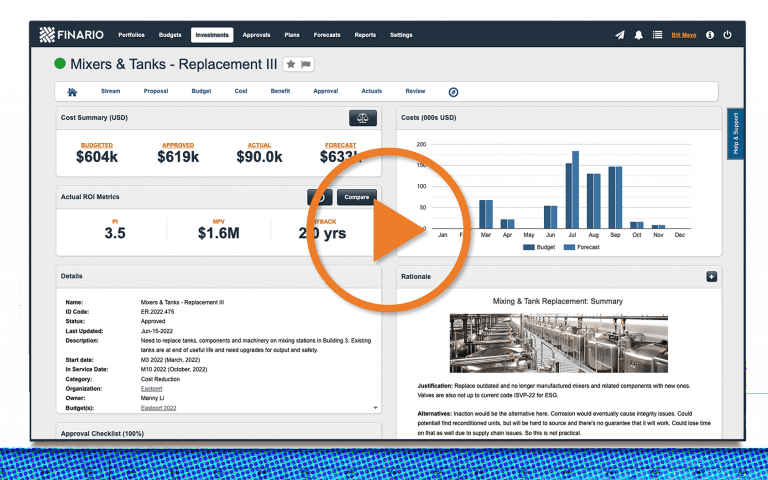
Finario gives finance and operations teams a shared view of capital investments, from initial requests and approvals through budgeting, forecasting, and portfolio reviews. When demand or project costs change, teams can reassess priorities against the same financial assumptions rather than piecing together separate spreadsheets.
With that shared view, teams can:
- See the full capital portfolio in one place, rather than project by project.
- Have visibility into every project’s status, current spend, and ROI projection.
- Manage cash flow aggressively with actuals feeding to and from their ERP into every project and portfolio.
- Apply consistent financial and business logic to every investment decision.
- Compare projects and priorities against strategic objectives.
- Run what-if scenarios before committing capital.
- Understand the impact of changing assumptions, such as a slipping customer timeline or higher construction costs.
- Reforecast and reprioritize as conditions change.
- Connect finance and operational stakeholders around the same capital plan.
- Adjust investment decisions without losing visibility or control.
Go back to our hypothetical switchgear manufacturer. With a centralized capital plan, teams can answer questions about phasing plant completion, cancelable commitments, and competing projects against live assumptions, with finance and operations using the same numbers. The final decision may not change, but leadership can evaluate the trade-offs sooner, using the same assumptions across finance and operations.
The AI infrastructure boom is real. So are the risks of underinvesting … and overinvesting to meet demand, and how those expenditures are timed and executed. It’s why precise, data-informed enterprise capital planning is so critical to meet the moment.
Watch our product
overview video