
— Strategic Capital Allocation—
How an asset-intensive business closed the gap between objectives and outcomes.
Challenge: Last Year's Budget, This Year's Plan
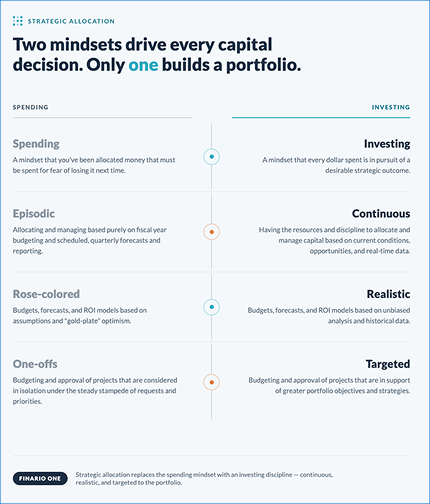
At most capital-intensive organizations, the annual budget process follows a familiar pattern: last year’s allocations serve as the baseline, business units submit incremental requests, and the portfolio takes shape through negotiation rather than strategy. It was no different in this case.
The consequences compounded quietly. Capital got deployed toward legacy investments with diminishing returns, while higher-potential growth initiatives had to compete on the same terms as routine maintenance requests. And there was no infrastructure to rebalance the portfolio when supply chains were disrupted, a new competitor entered the fray, or a new regulatory requirement emerged.
Opportunity: From Episodic Budgeting to Continuous Capital Intelligence
Strategic capital allocation requires the right data, the right visibility, and a process that continuously connects project-level decisions to portfolio-level outcomes, not just at budget time.
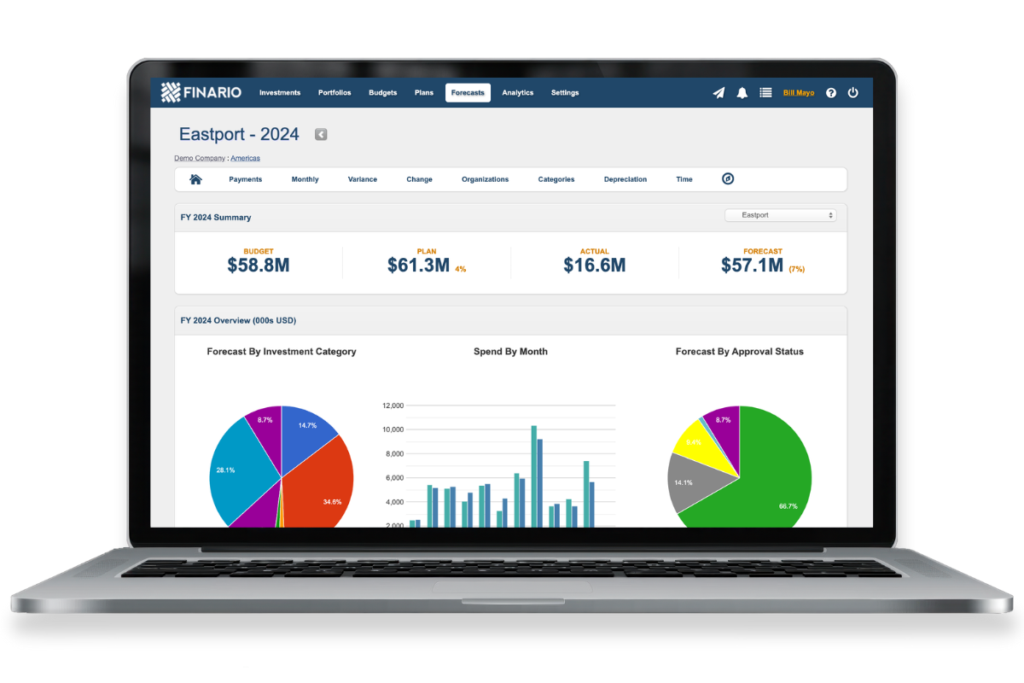
With Finario, they can now evaluate every capital request against defined strategic objectives. Finance and operations teams test different portfolio compositions before committing.
When conditions change mid-year, the platform supports dynamic reallocation, surfacing underperforming or stalled projects and flagging capital that could be redirected to higher-priority investments. The result is higher return on invested capital and a leadership team that knows exactly how and what to report.
A 5-Point Project Prioritization Action Plan
Define your allocation framework before the budget cycle opens.
Before requests are submitted, define the strategic objectives that will govern allocation decisions and assign relative weights. This framework becomes the lens through which every opportunity is evaluated.
Evaluate every material project against strategic objectives, not just financial returns.
ROI matters, but it isn't the whole story. Build a scoring model in Finario that weights financial and non-financial criteria according to your framework so that the portfolio reflects the full range of the organization's obligations, not just the projects with the shortest payback periods.
Model portfolio scenarios before committing.
Before the budget is finalized, run scenario models that show the aggregate impact of different funding combinations, including return profile, cash flow by period, strategic coverage, and risk exposure. And test the portfolio against a range of conditions. Continuous, data-driven modeling is what separates strategic allocation from episodic budgeting.
Build in structured mid-cycle reallocation reviews.
Evaluate individual projects and the portfolio as a whole against current strategic realities. Stalled projects, scope changes, and shifting market conditions should trigger a deliberate reallocation process, not a year-end write-off.
Track actual returns against original projections — and use what you learn.
Capture the ROI assumptions embedded in every material project submission, then track actual performance against those projections at defined intervals post-completion. These post-completion audits help turn one-off decisions into targeted, portfolio-level strategy.
Trusted by industrial enterprises worldwide
We now have complete visibility into all of our projects, and great compliance for capital versus expense. Finario truly delivers on what it says it will.
VP FINANCE, Global Packaging Leader
Finario provides a level of transparency that promotes better investment decisions.
Director of Strategy & Corporate Development Manufacturing
We were impressed by Finario’s range and attractive total cost of ownership.
FP&A Exeuctive, Metals
Solution Plan: Schedule a Demo
Get a guided walkthrough of Finario, tailored to how your leadership team prioritizes, chooses, manages and tracks strategic capital investments.